Showing posts with label sarah gumbley. Show all posts

Thursday, November 25, 2010

SURRENDER by Donna Malane reviewed in today's NZLawyer magazine

Today the print issue of NZLawyer magazine, which goes out to nearly 10,000 lawyers, judges, politicians and others in New Zealand, included a review of SURRENDER, the debut crime novel from Wellington-based author Donna Malane.

The reviewer was Sarah Gumbley, a literary fiction buff who is increasingly appreciating more crime fiction, and who has also provided several guest reviews to Crime Watch in recent times.

With the editor's permission, I am sharing Sarah's here with you all (since unless you are a Kiwi lawyer, judge or politician, you're unlikely to have access to the print version of NZLawyer magazine - and unlike the news and feature articles, the reviews aren't placed online).

Surrender
By Donna Malane (New Zealand Society of Authors, 2010)
Reviewed by Sarah Gumbley

The winner of the first NZSA-Pindar Publishing Prize, an award given to the best unpublished manuscript in New Zealand, was announced in June. While over 500 entries were received, ranging from poetry and short story collections to adult fiction of varying genres, it was a crime fiction tale from a Wellingtonian that impressed the judges the most. Since the announcement the people at Pindar have been busy turning that manuscript into a book for the shelves, and the result was released in September. Donna Malane’s Surrender can now be purchased in good bookstores throughout the country, and is well worth every penny.

Surrender follows freelance researcher Diane Rowe. Her subject: missing persons. Sometimes she works for the police, sometimes for private investigators, and other times for anyone else that wants to track down someone they miss. Her latest job is for the police force, and seems to be a rather tricky one. A body was discovered, old, and mostly decayed, in the Rimutaka State Forest. But this time it’s a struggle to figure out who this John Doe is. There are no persons listed as missing on the register that match up to the JD, but how could a man go missing without a single person noticing? Worse still, storms over the years will have shifted the body around the ranges, making it almost impossible to figure out the spot where the man died.

But at the same time, Rowe is working on another investigation – however this one is personal. She finds out that Snow, the suspected killer of her sister, Niki, who was murdered a year ago, has just been discovered, dead. Snow has been stabbed in the back with a boning knife, identical to the way that Niki was killed. But who killed him, and why? The more she investigates, the more a tangled web emerges, a web that makes Niki’s life appear a lot more sinister than Diane ever imagined. Just what was her sweet baby sister getting up to that she didn’t know about? Sometimes, some truths should stay buried.

Donna Malane is already an award-winning television producer and scriptwriter, and her partner, Ian Wedde is a novelist, so it’s no surprise she has come out with a really great tale. Surrender is fast-paced and edgy. I finished it within a few days, as I just had to find out what had happened. Diane Rowe, its main character is tough and rough but she’s also very likeable, which will make her last over the series. The judges of the award, New Zealand Herald Books Editor Linda Herrick, acclaimed editor and fiction writer Graeme Lay, and Pindar Publishing’s Mia Yardley, have made a good decision in picking this story and I look forward to seeing what further excellent books this award produces in the coming years.

---------------------------------------------------------------------------------------------------------------------

So what do you think of Sarah's review? Have you read SURRENDER? If not, does it sound like the kind of book you might want to try? Thoughts and comments welcome.


Monday, September 6, 2010

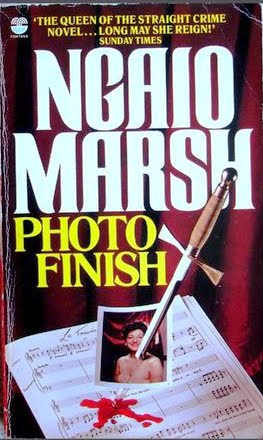
Review of PHOTO FINISH by Ngaio Marsh

In the latest of what will become a much more frequent occurrence in the coming weeks and months, today we have another great 'guest review' on Crime Watch. Moving forward, as well as my own reviews, and links to my own or others' relevant reviews published elsewhere, Crime Watch will also include guest reviewers writing crime and thriller fiction reviews specifically for this site. If you would like to contribute such a review, please let me know.

Sarah Gumbley (pictured above right) is an Auckland based book reviewer, who reads a lot of literary fiction, biographies, and other non-fiction works, as well as enjoying some crime and thriler fiction. She has also reviewed for Good Reading, NZLawyer, and Scoop Review of Books in the past.

Sarah has also set up her own excellent and growing books-related website, Literatlas, which aims to encourage readers around the globe to value books and their impact on the world. You can visit her site here and its Facebook page here.

With the inaugural presentation of the Ngaio Marsh Award for Best Crime Novel (hopefully) looming later this week, today Sarah reviews PHOTO FINISH by Ngaio Marsh - one of only four of the 32 Inspector Alleyn novels the doyen of New Zealand detective fiction wrote to actually take place in her home country of New Zealand, and her second to last novel of her 48-year publishing career.


PHOTO FINISH
By Ngaio Marsh (originally published by Collins, 1980)
Reviewed by Sarah Gumbley

With the first Ngaio Marsh Awards being held this month in Christchurch, it seemed a perfect time to revisit Marsh’s work, and her novel, Photo-Finish, a good place to start. One of the few tales to be set in New Zealand, Photo-Finish (part of the Inspector Alleyn mysteries) was originally published thirty years ago, but was reprinted as part of the Diamond Anniversary Collection last year.

Britain’s Chief Superintendent, Inspector Roderick Alleyn and his wife, Troy, an artist, both receive invitations from Montague Reece to stay at his new home, a lavish island retreat, on Lake Waihoe, New Zealand. Reece invites them with a request for each. It is hoped that during the stay, Troy will paint a portrait of the world-famous opera singer, Isabella Sommita, who will also be at the lodge. Alleyn, he requests, may help them solve a mystery of a photographer who has been harassing Isabella recently, taunting her with his unflattering images published in all the newspapers. They want to know who he is, and how to stop him.

When the Alleyns arrive at the house, all attention is focused on the performance to be held on the island in a few days. Isabella, the rotund star, will be singing a piece written especially for her by her protégé and lover, the young and handsome Rupert Bartholomew. The play is said to be terrible, but Isabella, so in love with the writer, insists it is a masterpiece. In any case, the whos-who of New Zealand theatre have all been invited already to see it on the island.

But in the evening after the performance, Madame Sommita is brutally murdered. The murder occurs just as a huge storm brews, meaning they’re all trapped on the island… along with the murderer. So the Inspector begins to investigate, at least until the New Zealand police can be contacted and brought in. It’s a tricky case to solve though as Isabella had plenty of enemies: there’s the paparazzi photograher, there’s her suspicious Italian mafia foes and then there’s the servants and other members of the household, who are all-too-aware of just how difficult she can be.

As is her style, Photo-Finish has a ‘play-like’ feel to it. The first page lists the ‘cast of characters’ and the setting is based on a single ‘stage’, being the island. Theatre was Marsh’s foremost passion (her ‘damery’ was largely awarded for her work in reviving New Zealand’s ailing theatre scene) so it is no wonder this all comes through. But as is the case with all her tales, it is simply a wonderful story. The kind that you want to finish in one go, that keeps you guessing until the last moment. But what else would you expect from Marsh? After all, she is one of the ‘crime queens’ of the English language.

-------------------------------------------------------

As Sarah mentioned, you can now purchase PHOTO FINISH as part of a three book set (along with LIGHT THICKENS, the final Alleyn tale, and BLACK BEECH AND HONEYDEW, Dame Ngaio's autobiography) of reissued Marsh classics, that were released late last year and early this year, in celebration of both 75 years since the first Alleyn tale, and sixty years since the 'Marsh Million', when I understand Marsh became one of only four authors of the time to have one million of her novels released onto the market in a single day.

The Ngaio Marsh collection volumes (11 in total, containing the 32 Alleyn novels and the autobiography) seem like a great way to collect a few Ngaio Marsh tales.

So, what do you think of Sarah's review? Do you like the Guest Reviews addition to Crime Watch? Do you like the sound of PHOTO FINISH? Does Golden Age crime writing (even if it was written in the 1970s-1980s appeal? Thoughts and comments welcome.

Wednesday, August 25, 2010

Review of DEATH IN THE LATIN QUARTER

In the latest of what will become a much more frequent occurrence in the coming weeks and months, today we have another great 'guest review' on Crime Watch. Moving forward, as well as my own reviews, and links to my own or others' relevant reviews published elsewhere, Crime Watch will also include guest reviewers writing crime and thriller fiction reviews specifically for this site. If you would like to contribute such a review, please let me know.

Sarah Gumbley (pictured above right) is an Auckland based book reviewer, who reads a lot of literary fiction, biographies, and other non-fiction works, as well as enjoying some crime and thriler fiction. She has also reviewed for Good Reading, NZLawyer, and Scoop Review of Books in the past.

Sarah has also set up her own excellent and growing books-related website, Literatlas, which aims to encourage readers around the globe to value books and their impact on the world. You can visit her site here and its Facebook page here.

Today, Sarah reviews DEATH IN THE LATIN QUARTER by Raphael Cardetti - "in Paris the magnificent tranquillity of the Sorbonne university is shattered by a death".


DEATH IN THE LATIN QUARTER
By Raphael Cardetti (Abacus, July 2010)
Reviewed by Sarah Gumbley
They say imitation is the sincerest form of flattery. Love it or hate it, Dan Brown’s The Da Vinci Code spurred a flurry of crime fiction books based in the art world, all hoping to emulate its success. Cardetti, a French author, was no different with his debut novel, Death in the Latin Quarter. Like Brown’s bestseller, it wanders between the present day and events in ancient times, reveals sins of leaders in the Catholic Church and focuses on crimes involving precious artworks. Originally written in French, the English version has recently been released.

Set in Paris, Death in the Latin Quarter revolves around a mysterious book that would confirm the existence of Vasalis, a (fictional) monk from the time of (the real) Pope Clement IV. Vasalis was considered a heretic for his publishing of De forma mundi but had since faded into oblivion and become merely a myth. The hunt for evidence of Vasalis had taken place for decades, but four people in particular find their search comes with deadly consequences.

First there is the Professor, Albert Cadas at Sorbonne University in Paris. He had been there as long as anyone could remember, so it comes as a shock when one day he supposedly commits suicide by jumping out the window of his office. It is especially shocking to his student, David Scotto, under his guidance for his PHD, which was focused around Vasalis at his Professor’s insistence. But if he didn’t commit suicide, what happened to him? Scotto is determined to find out.

Then there’s Valentine Savi, once the Lourve’s top art restorer, she had since faded into oblivion since a scandal at her former workplace in 2007. At the time, she had been working on a Da Vinci sketch when she accidentally destroyed it, leaving not only the painting, but also her career in ruins. Since then she had worked in a tiny workshop restoring insignificant family paintings. Until one day, Elias Stern, the biggest name in the art world comes knocking on her workshop door asking her to come and work for him. He still believes she’s the best restorer around despite the scandal, and needs her help on an important project: he’s found a book that may just prove this mysterious Vasalis is real after all.

The author, Raphael Cardetti, knows his setting well. He is currently a Professor of Italian History at the Sorbonne University. Perhaps this is what has allowed him to write the setting and its characters with such ease. It is a reasonably enjoyable read and the translator has done an impressive job of maintaining the feel and piece of the story, which can so easily be lost. Towards the end of the story it does becomes somewhat of an unexpected and unrealistic blood bath. But personally, while overdone, I do find murders in the art world make a particularly interesting type of criminal activity.

-------------------------------------------------------

So, what do you think of Sarah's review? Do you like the Guest Reviews addition to Crime Watch? Do you like the sound of DEATH IN THE LATIN QUARTER? Does crime and thriller fiction set in the art or university worlds appeal? Thoughts and comments welcome.

Saturday, August 21, 2010

Review of ANATOMY OF MURDER by Imogen Robertson

In the latest of what will become a much more frequent occurrence in the coming weeks and months, today we have another great 'guest review' on Crime Watch. Moving forward, as well as my own reviews, and links to my own or others' relevant reviews published elsewhere, Crime Watch will also include guest reviewers writing crime and thriller fiction reviews specifically for this site. If you would like to contribute such a review, please let me know.

Sarah Gumbley (pictured above right) is an Auckland based book reviewer, who reads a lot of literary fiction, biographies, and other non-fiction works, as well as enjoying some crime and thriler fiction. She has also reviewed for Good Reading, NZLawyer, and Scoop Review of Books in the past.

Sarah has also set up her own excellent and growing books-related website, Literatlas, which aims to encourage readers around the globe to value books and their impact on the world. You can visit her site here and its Facebook page here.

Today, Sarah reviews ANATOMY OF MURDER by Imogen Robertson, a historic crime thriller.


ANATOMY OF MURDER
By Imogen Robertson (Headline, August 2010
)
Reviewed by Sarah Gumbley
‘You’ve got to be in to win’ seems the lesson to be learned from successful English novelist Imogen Robertson. Only two years ago she was just another unknown author. That year, however she won the Guardian first book prize, awarded to unpublished writers. After submitting 1,000 words of the story she wanted to write, she won the competition and went on to have the rest of the novel financed and published. That became her debut novel, INSTRUMENTS OF DARKNESS, which received much recognition and was published in a number of countries. Now, Robertson has released her second novel, ANATOMY OF MURDER, once again, a heady mix of historical fiction and crime fiction set in eighteenth-century England.

The year is 1781, and England is at war with both America and France. The book opens with the much-loved British Captain Westerman sailing his ship, HMS Splendour, when it comes across a French boat in her path, and the two ships begin firing on each other. Back on land, and a few months later, Captain Westerman’s wife, Harriet, and her dear friend Crowther are once again asked to solve a mysterious murder, in London, when the body of a man is found dredged up from the River Thames. Intertwined with all this is the story of tarot card reader, Jocasta Bligh. With pet dog, Boyo, by her side, she reads the fortunes of visitors each day, but when an unlucky girl comes by, the cards read of an unimaginable horrors, and Bligh is forced to chase her down to save her from certain strife. Along the way she picks up street urchin, Sam, a ten-year-old orphan, a kind-hearted child, willing to help Bligh with anything for a warm bed and a snack to eat.

It was a rocky start; the ship attack in the prologue didn’t quite capture me, but the more I read, the more the story enveloped me, and there are some beautifully-written lines; “London rolled over in its bed and yawned at the approaching morning, then cursed it”. The story is believable, and effortlessly takes the reader back to 1781. No doubt this is because Robertson has completed thorough research for the background of this book, and based many of the people and events on truth. For example, the castrati did exist and the character of Lord Sandwich is largely based on a real person of the same name. However, it would have helped to read INSTRUMENTS OF DARKNESS first. While ANATOMY OF MURDER does stand on its own, it seems assumed that the characters are already known to the reader, so it felt like I was missing part of their story. That’s not necessarily a bad thing though. It’s certainly made me want to go out and purchase the first tale.
-------------------------------------------------------

So, what do you think of Sarah's review? Do you like the Guest Reviews addition to Crime Watch? Do you like the sound of ANATOMY OF MURDER? Have you read it, or INSTRUMENTS OF DARKNESS? Does crime and thriller fiction set in historic times appeal? Thoughts and comments welcome.