“Ngaio Marsh – Crime Queen”
A Film Screening – One Night Only
A fundraising screening for The Court Theatre
Hosted by Peter Elliott as Inspector Roderick Alleyn
When: Monday 26 September 2011, 7.30pm
Cost: $25 per ticket
Where: The Aurora Centre for The Performing Arts, cnr Greers Rd & Memorial Ave
Run time: 70 mins – plus a Q&A for 20 minutes with the film makers.
DVD’s: DVD’s of Ngaio Marsh – Crime Queen will be sold with tickets and on the night at a reduced price
Cost: $20 – with all proceeds also going to “The Shed.”
Books: Harper Collins NZ is presenting the compendium of Ngaio’s detective stories and a signed copy of Joanne Drayton’s biography of Ngaio Marsh which will be raffled. on the night. Cost: $10 per ticket (Retail value $300+)
Total package: Ticket & DVD - $45
bookings@courttheatre.org.nz or Ph: 03 963 0870
All funds raised will go to the Court Theatre’s fundraising appeal for “The Shed.”
This event is funded by Creative New Zealand.
You can read more about the film, Ngaio Marsh - Crime Queen, below.
“Ngaio Marsh – Crime Queen”
(The Unsolved Mystery)
Detective Inspector Alleyn on the case of his creator, Ngaio Marsh
Chief Inspector Roderick Alleyn (Peter Elliot), the urbane English police officer and the detective who stars in all thirty two of Ngaio Marsh’s internationally renowned best selling detective novels, comes to life to go in search of his creator, Ngaio Marsh.
In his investigation Alleyn is teased by glimpses of Ngaio as she walks down a London street, sits reflecting in a café or slips into a radio studio for a recording. ‘Ngaio’ is adept at luring her Detective on, only to evade and escape revelation. This is a cat and mouse game played by two professionals. Who is stalking who and why? Does Ngaio want to be discovered, to finally reveal who she is behind her masks? If anyone can coax out the fact behind the fantasy, it is her Detective Inspector.
Alleyn leads the investigation into what is behind the masks and hidden in the fantasies - the contradictions and controversies of his mistress’s life. Ngaio Marsh has been the architect of his fictional world; now he explores her factual world. Does his investigation enable him to better understand the complex nature of his creator?
Does he discover that Ngaio Marsh’s fictional and factual worlds blur – or that he, a fictitious creation, is, in fact, an essential character in his mistress’s life. Ngaio Marsh – Crime Queen is on the case.
Dame Ngaio loved her city and she loved the theatre; this is her night to help out.
The filmmakers will hold a Q & A following the screening, which will include producer/director Aileen O’Sullivan, and actor Peter Elliot who features as Ngaio’s Detective Inspector Roderick Alleyn in Ngaio Marsh – Crime Queen.
NZ on Air and TVNZ funded the making of “Ngaio Marsh – Crime Queen”.
For more information contact – Ali Jones, Ali Jones PR (for The Court Theatre) on 027 247 3112
NB – Remember - $10 for raffle of Compendium of Ngaio Marsh books (ALL 32)
-----------------------------------------------------------------------------------------------------------
This sounds like a terrific evening out - and I'd heartily encourage anyone in the Canterbury region, or driving distance away, to head along and support a great cause. Dame Ngaio actually received her 'damery', as she called it, largely for her work with New Zealand theatre - she was a driving force behind creating a theatre culture in New Zealand, and I'm sure she would love that a documentary about herself is being used to raise funds for the Court Theatre, an iconic theatre in Canterbury that, like many other things there, has been adversely affected by the series of devastating earthquakes over the past year.
Showing posts with label dame ngaio marsh. Show all posts
Thursday, September 1, 2011
Thursday, March 24, 2011
NZBM Review: DIED IN THE WOOL by Ngaio Marsh
Died in the WoolBy Ngaio Marsh (HarperCollins, 1945)
Reviewed by Craig Sisterson
To close out NZLawyer’s celebration of New Zealand Book Month, it seems only fitting to look at a book from one of our all-time greatest authors, perhaps our most popular ever on the global stage, whose books are still in print more than 75 years after she was first published – our Grande Dame of mystery writing, Ngaio Marsh.
Christchurch born-and-raised Marsh penned 32 murder mysteries starring her English gentleman detective Inspector Roderick Alleyn between 1934 and her death in 1982, and is world-recognised as one of the ‘Queens of Crime’ of the Golden Age of Detective Fiction (alongside Agatha Christie, Dorothy Sayers, and Margery Allingham), with international critics even calling her “the finest writer in the English language of the pure, classical, puzzle whodunit”.
Died in the Wool is one of four Alleyn tales Marsh set here, and is made even more interesting as it was actually published during the Second World War, and incorporates aspects, issues, and perspectives on the war climate into the murder mystery plotline. Being written before Marsh would have even known when or how the war would end, some of the settings and characterisations can give insights into New Zealand at that time that no recently written historical novel, no matter how well researched, can match.
One summer evening in 1942, formidable Member of Parliament Florence “Flossie” Rubrick goes to the wool shed on her high country property to rehearse a patriotic speech, and disappears. Three weeks later, she’s found – dead inside a bale of wool at an auction. Inspector Alleyn, in New Zealand on war security matters, comes to the high country sheep station more than a year later, after Rubrick’s husband has also passed away from illness, and tries to piece together what really happened to the polarising MP, based on the testimonies of several acquaintances. At the same time, concerns are raised about the top-secret security work being carried out by two young men – have the blueprints for the new anti-aircraft device been leaked?
In effect, Marsh has transported the classic British ‘country house’ murder mystery, with its closed environment and small amount of characters – all of whom have a motive for killing the victim, into a rural New Zealand setting during the war. But she also does a few things differently that help Died in the Wool stand out. Alleyn arrives months after the murder, so can’t rely on the crime scene clues and observations usually available to detectives – instead he has to weigh the differing recollections of the residents (each has its own chapter, eg “According to Terence Lynne”). This device gave Marsh not only a different structure and investigative method, but the opportunity to ‘voice’ varying views and concerns about what was going on during the war, through her different characters.
In general, Marsh’s plots weren’t quite as intricate as Christie’s puzzles, but she was the superior writer when it came to setting, description, and giving her characters more depth and layers. Compared to today’s crime novels, the pace is somewhat languid, and at times, the language used dates the book, but decades after it was published, Died in the Wool remains an absorbing, enjoyable read.Reprinted many times over the decades, Died in the Wool is now available as Volume 5 (in trio with Final Curtain and Swing, Brother, Swing) of the Ngaio Marsh Collection set of omnibus editions, published by HarperCollins UK to commemorate Marsh’s Diamond Anniversary.
---------------------------------------------------------------------------------------------------------------------
This article was published in today's (25 March 2011) issue of NZLawyer, and is republished here with permission.
---------------------------------------------------------------------------------------------------------------------
Have you read DIED IN THE WOOL? Any of Ngaio Marsh's murder mysteries? Do you still enjoy 'old style' cosy mystery novels? What makes them so re-readable decades later?
Monday, February 7, 2011
Ngaio Marsh docu-drama to screen on TV ONE next weekend
Last year I heard through the grapevine that a television documentary on our own Dame Ngaio Marsh was in the works. Now it appears the hard work of many people, including driving force producer/director Aileen O'Sullivan, has come to fruition, with the welcome news that Ngaio Marsh - Crime Queen will screen as part of TVNZ's Artsville series late next Sunday night (13 February). Here is the press release information from the Big Idea website:[This week's] Artsville is a docu-drama about New Zealand’s iconic writer of detective fiction, Ngaio Marsh.
Chief Inspector Roderick Alleyn (Peter Elliott, Until Proven Innocent), the urbane English police officer and detective who stars in all thirty two of Marsh's internationally renowned best selling detective novels, comes to life to go in search of his creator.
Respected Kiwi actor Peter Elliott (pictured above, as Alleyn) says of his role, "I found playing Detective Inspector Roderick Alleyn one of the most peculiar experiences of my life. It was like shipping coals to Newcastle, interviewing Eton and Oxford educated personalities in England as a private school, University educated, upper class character. It was a phenomenon both very odd and most enjoyable, this process of sleuthing around."
Elliott concludes, "Ngaio Marsh has joined the company of people to whom I am very grateful. She came to feel like a compatriot, a parent, a friend. I came to feel like one of Ngaio's Boys."
Producer/ director Aileen O'Sullivan says of making the show and learning more about Marsh: "It is a documentary I have wanted to make for several years and found the figure we discovered even more complex, more extraordinary and more engaging than I'd originally suspected."
Sullivan discovered Marsh fans exist in all corners of the globe, she says "we shot in Christchurch, New Zealand and in England, and in both countries were given tremendous support by crime aficionados and the friends and colleagues who treasure and respect Ngaio Marsh's work. It was strange to realise that while Dame Ngaio Marsh has been well celebrated here as a theatre director, the huge reputation she enjoys internationally as one of the all time Queens of Crime Fiction, has never been fully appreciated in New Zealand."
In Artsville: Ngaio Marsh - Crime Queen Chief Inspector Roderick Alleyn is teased by 'glimpses' of 'Ngaio' during his investigation as she walks down a London street, sits reflecting in a café or slips into a radio studio for a recording. 'Ngaio' is adept at luring her Detective on, only to evade and escape revelation.
This is a cat and mouse game played by two professionals. Who is stalking who and why? Does Ngaio want to be discovered, to finally reveal who she is behind her masks?
I understand Artsville is usually screened at approximately 11pm, so it will be a late night for the Ngaio fans out there (or perhaps some MySkying will occur). For those who can't watch it 'live' this Sunday, so to speak, I understand that TVNZ usually makes its Artsville programmes available online following screening - just go to http://www.tvnz.co.nz/ and look in the On Demand section of the website.
Sunday, January 9, 2011
Crime Fiction Alphabet, Part II
From October 2009 to April 2010 a group of keen crime fiction bloggers participated in the excellent Crime Fiction Alphabet series created by my fellow Anzac and book blogger Kerrie at Mysteries in Paradise. Each week bloggers would post about a crime fiction author whose first or last name started with the letter of the week, or a crime fiction title that began with that letter of the alphabet.The series was a lot of fun, and has now returned. Unsurprisingly, this first week's letter is 'A' (funny, that). You can read more about this new series here at Mysteries in Paradise.
For my second crack at this series, I've decided to try to use all completely new authors and books - no post is allowed to be the same as last time. You can see all my previous posts, from A to Z (or in my case, from Ngaio Marsh's A MAN LAY DEAD to Canadian author Mark Zuehlke) below:
The Crime Watch Crime Fiction Alphabet line-up was as follows:
A is for A MAN LAY DEAD
B is for Burke, James Lee
C is for Connelly, Michael
D is for Dorothy Fowler
D is (also) for Deverell, William
E is for Ellery Queen
F is for FAT TUESDAY
G is for Green, Michael
H is for Harlan Coben
I is for Ian Sutherland
J is for Joan Druett
K is for Kelly, Lindy
L is for Linwood Barclay's FEAR THE WORST
M is for Marsh, Dame Ngaio
N is for Neil Cross
O is for OR SHE DIES
P is for Peter Robinson and THE PRICE OF LOVE
Q is for Qiu Xiaolong
R is for THE RINGMASTER
S is for THE SILENT HOUR
T is for TROPIC OF DEATH
U is for Unger, Lisa
V is for Vanda Symon
W is for WHAT REMAINS BEHIND
X is for Xiaolong's THE MAO CASE
Y is for Yrsa Sigurdardottir
Z is for Zuehlke, Mark
Not a bad line-up. It will be interesting to see what everyone comes up with for this second series (I see Agatha Christie's AND THEN THERE WERE NONE is once again a popular choice for 'A' week). I will be publishing my 'A' post here on Crime Watch later this week.
In the meantime, have a read through some of the above posts, and pop over to Mysteries in Paradise to check out what my fellow alphabetically-inspired bloggers are talking about.
Sunday, December 5, 2010
MURDER IN THE SECOND ROW: another 2010 Kiwi crime fiction debut!
I was trawling around the Internet in the past couple of days, looking for some New Zealand crime fiction-related content, when I stumbled upon another New Zealand-based author who had published a debut murder mystery this year.Bev Robitaille is a photographer for publications in New Zealand and overseas and a freelance writer for magazines like Next. Born in the UK, she has lived on Auckland's North Shore for 12 years, and spent the prior two decades in Nelson (my hometown). Her first crime novel, MURDER IN THE SECOND ROW, was launched at the Theatre Royal in Nelson earlier this year (the eagle-eyed among you will have noted the name discrepency on the book jacket - Robitaille has published her murder mystery under the name Bev Robitai). Here is the blurb for the debut mystery:
"There are many things that can go wrong between casting a show and Opening Night. Finding a body in the second row is just one of them.
Jessica Jones is well aware that the old Regent Theatre is at crisis point. As theatre manager she is responsible for most of the productions staged there, and this show is the last chance to prove that the place can make enough money to be worth saving.
Rehearsals begin, and it’s not long before hot little Tamara Fitzpatrick is distracting all the guys under 70 with her wicked ways. Someone disapproves, and Tamara is found dead in the auditorium after the promotional photoshoot.
Now Jessica has to cope with finding a replacement for Tamara, and finding a new rehearsal venue. And as if life wasn’t complicated enough, Jack Matherson, the police officer heading the investigation, seems to be taking an unusual interest in her."
There is of course a great tradition of mixing murder mysteries and the theatre. Our very own Dame Ngaio Marsh, who was awarded her "damery" for services to theatre - she played a strong role in resurrecting the flagging theatre scene in New Zealand, set several of her Inspector Alleyn mysteries in theatre-related locations. I am currently reading MURDER IN THE SECOND ROW, having purchased an ebook copy on Smashwords (a good option for overseas readers of Crime Watch; it's available at a very reasonable price there).
For those in New Zealand who'd like a hard copy of the book, I understand that Borders Albany is stocking the book, and it is also available for order from online booksellers Wheelers.
It's great to see more New Zealand-written crime fiction hitting booksellers shelves (online and physical). Maybe it's just my skewed perspective, but I really do think we have something building here downunder, and its great to see.
Do you like the sound of MURDER IN THE SECOND ROW? Do you like murder mysteries set in the world of theatre? If you've read it, what do you think? Thoughts and comments welcome.
Tuesday, September 28, 2010
Kiwi Author skewers Dame Ngaio? Taking a look at BLUE BLOOD by Stevan Eldred-Grigg
Recently I headed down to Nelson (my hometown) for a bit of a break, and browsed a couple of cool secondhand bookstores while I was there. There are a handful of out of print Kiwi crime books and authors that I've been trying to find copies of for quite a while, so I'm always looking out for them, along with any other books that fall within the genre that I might stumble upon. At one store I ended up walking out with about 8-10 such 'forgotten' Kiwi crime novels, including three I'd been trying to find for ages - one of which was BLUE BLOOD by Stevan Eldred-Grigg.
Eldred-Grigg isn't someone most New Zealanders would associate with crime fiction - he's an historian and author who writes in a eclectic variety of 'genres' and styles. When I was at high school we had to read ORACLES AND MIRACLES, his first novel. It's a story about two girls "living in a world of dreams while growing up in poverty" in historic Christchurch. I remember thinking it was okay, but not that great - but in fairness that was probably more to do with being a high school student who read a lot, and so was primed to be a little against the 'old, boring stuff' that the teachers 'forced' on us. I do remember enjoying the novel more than I thought I would (I thought it was okay, whereas most of my classmates hated it), and I'd probably appreciate a lot more about it if I read it now. Eldred-Grigg's most recent book is the acclaimed non-fiction work DIGGERS, HATTERS, AND WHORES, a very lively account of the gold rushes from the 1850s to the 1870s which were "the biggest single event in the history of colonial New Zealand".
Back in 1997 though, Eldred-Grigg wrote his one and only 'crime novel', a book that stirred a little controversy at the time. BLUE BLOOD is touted as a "parody, and a darkly comic deconstruction, of the classic interwar crime novel" - I'd stumbled across a reference to it online several months ago, and had been looking out for a copy ever since, so was stoked to discover one in the secondhand bookstore on Hardy Street in Nelson (opposite Lone Star). BLUE BLOOD is set in 1929, and the back cover blurb reads as follows:
"Summer, 1929. Three young women are rocketing across the hot Canterbury Plains in a fast roadster: smoking, drinking - laughing. But soon all this is to change. In a plot worthy of a Ngaio Marsh fiction, lives are about to be shattered by shafts of jealousy, madness and revenge.
The young Ngaio herself, seated at breakfast a few weeks later in the family bungalow on Cashmere, bites into a slice of toast and sight with irritation as her mother rustles the newspaper and comments on page one's shocking story. Two young local women, severely mutilated, pots of blue paint spilled on the bodies...
Stevan Eldred-Grigg's brilliant novel is a tough tale about a woman at the turning point of her creative and emotional life. It is also an enquiry - both mischievious and disturbing - into the psychopathology of a murder which might affect even the author herself."
It certainly sounds intriguing. On its release there was some media debate about whether or not the novel "cruelly defames... a cultural icon of New Zealand". Auckland journalist and reviewer Claudia Marquis called it "an enjoyable hour or two of bitchy pleasure". At least Dame Ngaio was being recognised as a cultural icon, I guess. In some ways we seem to have forgotten her a little now - at least in the wider public consciousness - although hopefully that is changing.
So I'm very much looking forward to trying BLUE BLOOD for myself, both to see Eldred-Grigg turn his hand to crime fiction (parody or not), and to form my own opinion on the (now largely-forgotten, like the book) controversy.
Have any of you read (or even heard of) this hard-to-find piece of New Zealand crime fiction history? What do you think of crime novels that incorporate fictionalised versions of real characters? Do you like scouring secondhand bookstores? What are some of the coolest books you've found in secondhand stores? Please share your thoughts and comments.
Saturday, September 11, 2010
Review of LIGHT THICKENS, the final book by Ngaio Marsh
In another great guest review here on Crime Watch, today Sarah Gumbley (pictured right) takes a closer look at LIGHT THICKENS, the 32nd and final Inspector Alleyn novel, which was originally published in 1982, the year of Dame Ngaio Marsh's death.Sarah is an Auckland based book reviewer, who reads a lot of literary fiction, biographies, and other non-fiction works, as well as enjoying some crime and thriler fiction. She has also reviewed for Good Reading, NZLawyer, and Scoop Review of Books in the past.
Sarah has also set up her own excellent and growing books-related website, Literatlas, which aims to encourage readers around the globe to value books and their impact on the world. You can visit her site here and its Facebook page here.
The postponement of the Ngaio Marsh Award (which will now be held later in the year) at least has given me a little extra time to fit in another review from the Diamond Anniversary Collection of Marsh’s works. So I chewed my way through LIGHT THICKENS, also one of the Inspector Alleyn mysteries. Just like PHOTO-FINISH it makes use of her experience in the theatre, but in this tale, the scene is set in London, where Marsh also spent a number of years.
Peregrine Jay is a theatre director and owner of London’s famed Dolphin Theatre. He decides that for his latest production he will put on Shakespeare’s tragedy, Macbeth. Jay successfully auditions a collection of great actors for the parts, even including theatre great, Sir Dougal Macdougal as Macbeth himself. He’s also got the brilliant Margaret Mannering as Lady Macbeth, and child prodigy William Smith as the son of MacDuff. Dress rehearsals all run well, and soon enough, they’re all ready for their opening night. Pleasingly, there’s at least one Kiwi in the book. Rangi plays one of the witches, and even introduces the haka into his performance.
However, Macbeth is known as the ‘unlucky play’. Whenever it is performed, odd things happen, and those in the theatre world consider it cursed. Jay determinedly believes it’s all nonsense, but that doesn’t stop strange occurrences arising during his production. Equipment goes missing, pranks seem to be played and the cast is put on edge, waiting for something worse. Despite the tension in the air, they all perform their parts perfectly, and the critics are impressed. They proclaim “At last! A flawless Macbeth!”
Then, six weeks in, disaster strikes. A key actor is murdered during the performance. As it happens, Inspector Alleyn is sitting in the audience that night, and so ends up leading the investigation into who committed the crime, and how. He is of course, assisted by his Scotland Yard colleagues, Detective Inspector Fox, and Detective Sergeants Thompson and Bailey.
By the time I was halfway through the story and no murder had been committed, I was starting to wonder if one was going to happen in time to be solved before the end of the book. But the tension was certainly in the air, and something terrible seemed inevitable. In the end, the killer wasn’t who I had been so certain it would be. I got a surprise when it was revealed in the last few pages. But I suppose that’s how it should be. Marsh is too good to ever be predictable.
-----------------------------------------------------------------------------------------------------------------------------
Peregrine Jay is a theatre director and owner of London’s famed Dolphin Theatre. He decides that for his latest production he will put on Shakespeare’s tragedy, Macbeth. Jay successfully auditions a collection of great actors for the parts, even including theatre great, Sir Dougal Macdougal as Macbeth himself. He’s also got the brilliant Margaret Mannering as Lady Macbeth, and child prodigy William Smith as the son of MacDuff. Dress rehearsals all run well, and soon enough, they’re all ready for their opening night. Pleasingly, there’s at least one Kiwi in the book. Rangi plays one of the witches, and even introduces the haka into his performance.
However, Macbeth is known as the ‘unlucky play’. Whenever it is performed, odd things happen, and those in the theatre world consider it cursed. Jay determinedly believes it’s all nonsense, but that doesn’t stop strange occurrences arising during his production. Equipment goes missing, pranks seem to be played and the cast is put on edge, waiting for something worse. Despite the tension in the air, they all perform their parts perfectly, and the critics are impressed. They proclaim “At last! A flawless Macbeth!”
Then, six weeks in, disaster strikes. A key actor is murdered during the performance. As it happens, Inspector Alleyn is sitting in the audience that night, and so ends up leading the investigation into who committed the crime, and how. He is of course, assisted by his Scotland Yard colleagues, Detective Inspector Fox, and Detective Sergeants Thompson and Bailey.
By the time I was halfway through the story and no murder had been committed, I was starting to wonder if one was going to happen in time to be solved before the end of the book. But the tension was certainly in the air, and something terrible seemed inevitable. In the end, the killer wasn’t who I had been so certain it would be. I got a surprise when it was revealed in the last few pages. But I suppose that’s how it should be. Marsh is too good to ever be predictable.
-----------------------------------------------------------------------------------------------------------------------------
As Sarah mentioned, you can now buy LIGHT THICKENS as part of a very reasonably-priced three-book set (along with PHOTO FINISH, the penultimate Alleyn tale, and BLACK BEECH AND HONEYDEW, Dame Ngaio's autobiography) of reissued Marsh classics.This latest Ngaio Marsh collection was released late last year and early this year, in celebration of both 75 years since the first Alleyn tale, and sixty years since the 'Marsh Million', when I understand Marsh became one of only four authors of the time to have one million of her novels released onto the market in a single day. The Ngaio Marsh collection volumes (11 in total, containing the 32 Alleyn novels and the autobiography) seem like a great way to collect a few Ngaio Marsh tales.
So, what do you think of Sarah's review? Do you like the Guest Reviews addition to Crime Watch? Do you like the sound of LIGHT THICKENS? Does Golden Age crime writing (even if it was written in the 1980s) appeal? What is your favourite Ngaio Marsh tale? Thoughts and comments welcome.
Monday, September 6, 2010
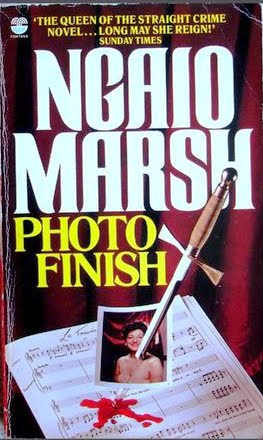
Review of PHOTO FINISH by Ngaio Marsh
In the latest of what will become a much more frequent occurrence in the coming weeks and months, today we have another great 'guest review' on Crime Watch. Moving forward, as well as my own reviews, and links to my own or others' relevant reviews published elsewhere, Crime Watch will also include guest reviewers writing crime and thriller fiction reviews specifically for this site. If you would like to contribute such a review, please let me know.Sarah Gumbley (pictured above right) is an Auckland based book reviewer, who reads a lot of literary fiction, biographies, and other non-fiction works, as well as enjoying some crime and thriler fiction. She has also reviewed for Good Reading, NZLawyer, and Scoop Review of Books in the past.
Sarah has also set up her own excellent and growing books-related website, Literatlas, which aims to encourage readers around the globe to value books and their impact on the world. You can visit her site here and its Facebook page here.
With the inaugural presentation of the Ngaio Marsh Award for Best Crime Novel (hopefully) looming later this week, today Sarah reviews PHOTO FINISH by Ngaio Marsh - one of only four of the 32 Inspector Alleyn novels the doyen of New Zealand detective fiction wrote to actually take place in her home country of New Zealand, and her second to last novel of her 48-year publishing career.
By Ngaio Marsh (originally published by Collins, 1980)
Reviewed by Sarah Gumbley
With the first Ngaio Marsh Awards being held this month in Christchurch, it seemed a perfect time to revisit Marsh’s work, and her novel, Photo-Finish, a good place to start. One of the few tales to be set in New Zealand, Photo-Finish (part of the Inspector Alleyn mysteries) was originally published thirty years ago, but was reprinted as part of the Diamond Anniversary Collection last year.
Britain’s Chief Superintendent, Inspector Roderick Alleyn and his wife, Troy, an artist, both receive invitations from Montague Reece to stay at his new home, a lavish island retreat, on Lake Waihoe, New Zealand. Reece invites them with a request for each. It is hoped that during the stay, Troy will paint a portrait of the world-famous opera singer, Isabella Sommita, who will also be at the lodge. Alleyn, he requests, may help them solve a mystery of a photographer who has been harassing Isabella recently, taunting her with his unflattering images published in all the newspapers. They want to know who he is, and how to stop him.
When the Alleyns arrive at the house, all attention is focused on the performance to be held on the island in a few days. Isabella, the rotund star, will be singing a piece written especially for her by her protégé and lover, the young and handsome Rupert Bartholomew. The play is said to be terrible, but Isabella, so in love with the writer, insists it is a masterpiece. In any case, the whos-who of New Zealand theatre have all been invited already to see it on the island.
But in the evening after the performance, Madame Sommita is brutally murdered. The murder occurs just as a huge storm brews, meaning they’re all trapped on the island… along with the murderer. So the Inspector begins to investigate, at least until the New Zealand police can be contacted and brought in. It’s a tricky case to solve though as Isabella had plenty of enemies: there’s the paparazzi photograher, there’s her suspicious Italian mafia foes and then there’s the servants and other members of the household, who are all-too-aware of just how difficult she can be.
As is her style, Photo-Finish has a ‘play-like’ feel to it. The first page lists the ‘cast of characters’ and the setting is based on a single ‘stage’, being the island. Theatre was Marsh’s foremost passion (her ‘damery’ was largely awarded for her work in reviving New Zealand’s ailing theatre scene) so it is no wonder this all comes through. But as is the case with all her tales, it is simply a wonderful story. The kind that you want to finish in one go, that keeps you guessing until the last moment. But what else would you expect from Marsh? After all, she is one of the ‘crime queens’ of the English language.
Britain’s Chief Superintendent, Inspector Roderick Alleyn and his wife, Troy, an artist, both receive invitations from Montague Reece to stay at his new home, a lavish island retreat, on Lake Waihoe, New Zealand. Reece invites them with a request for each. It is hoped that during the stay, Troy will paint a portrait of the world-famous opera singer, Isabella Sommita, who will also be at the lodge. Alleyn, he requests, may help them solve a mystery of a photographer who has been harassing Isabella recently, taunting her with his unflattering images published in all the newspapers. They want to know who he is, and how to stop him.
When the Alleyns arrive at the house, all attention is focused on the performance to be held on the island in a few days. Isabella, the rotund star, will be singing a piece written especially for her by her protégé and lover, the young and handsome Rupert Bartholomew. The play is said to be terrible, but Isabella, so in love with the writer, insists it is a masterpiece. In any case, the whos-who of New Zealand theatre have all been invited already to see it on the island.
But in the evening after the performance, Madame Sommita is brutally murdered. The murder occurs just as a huge storm brews, meaning they’re all trapped on the island… along with the murderer. So the Inspector begins to investigate, at least until the New Zealand police can be contacted and brought in. It’s a tricky case to solve though as Isabella had plenty of enemies: there’s the paparazzi photograher, there’s her suspicious Italian mafia foes and then there’s the servants and other members of the household, who are all-too-aware of just how difficult she can be.
As is her style, Photo-Finish has a ‘play-like’ feel to it. The first page lists the ‘cast of characters’ and the setting is based on a single ‘stage’, being the island. Theatre was Marsh’s foremost passion (her ‘damery’ was largely awarded for her work in reviving New Zealand’s ailing theatre scene) so it is no wonder this all comes through. But as is the case with all her tales, it is simply a wonderful story. The kind that you want to finish in one go, that keeps you guessing until the last moment. But what else would you expect from Marsh? After all, she is one of the ‘crime queens’ of the English language.
-------------------------------------------------------
As Sarah mentioned, you can now purchase PHOTO FINISH as part of a three book set (along with LIGHT THICKENS, the final Alleyn tale, and BLACK BEECH AND HONEYDEW, Dame Ngaio's autobiography) of reissued Marsh classics, that were released late last year and early this year, in celebration of both 75 years since the first Alleyn tale, and sixty years since the 'Marsh Million', when I understand Marsh became one of only four authors of the time to have one million of her novels released onto the market in a single day.
The Ngaio Marsh collection volumes (11 in total, containing the 32 Alleyn novels and the autobiography) seem like a great way to collect a few Ngaio Marsh tales.
So, what do you think of Sarah's review? Do you like the Guest Reviews addition to Crime Watch? Do you like the sound of PHOTO FINISH? Does Golden Age crime writing (even if it was written in the 1970s-1980s appeal? Thoughts and comments welcome.
Friday, August 13, 2010
Memories of a Dame: An encounter with Ngaio Marsh (guest post by author Roy Vaughan)
I used to cover the waterfront for the New Zealand Herald and it meant just about anything that was newsworthy: smuggling, strikes, shipping disasters, the arrival of Hundert Wasser in his hippy yacht the Regentag, and VIPs arriving on large ocean liners.I rather liked doing the liners being a bit of an early bird myself, as it involved getting down to waterfront as the sun came up and going out on the customs launch to interview persons of interest before they disembarked.
You never quite knew who to expect. It was common for PR companies to send in a blurb to the Herald in advance to get publicity on some showbiz person, but there were just as many persons of note that did not want publicity, and they often turned out to be more interesting.
I am pretty sure that was the case with Dame Ngaio Marsh when she turned up as a passenger on a P&O Liner back in the 1970s coming back to New Zealand.
I know I was totally unprepared for her - I had never read any of her books but knew of her reputation as a great crime writer. A Herald photographer accompanied me as there was generally a picture opportunity as well as a story on these liners, and someone in the pursers office tipped me off that she was on board. He was pretty ecstatic about the photo opportunity, knowing very well the Herald would most likely use it.
When you get that sort of tip-off you know the VIP probably does not want to be interviewed, so I had two problems: no pre-interview briefing, and someone who may give me the cold shoulder.
I know my way around ships having been at sea for eight years, so in a sense it was home territory for me. We made a request and got a message back saying she would see us, and she duly turned up at a lounge to be interviewed. She was sharp eyed, smart and organised in a sort of British Mem sahib colonial sort of way, and more British than I imagined. I don’t know why that surprised me as she had spent a very large part of her life in Britain.
At first she did not strike me as being a particularly arty sort of person who loved the theatre and Shakespeare because she was completely at home on board ship and told me how she had written a book or two on long sea voyages on cargo passenger ships. We talked about ‘Singing in the Shrouds,’ written on a Port Line cargo ship on a long voyage to or from, Britain.
It broke the ice that I used to be a deck officer on cargo passenger ships, so we could talk about ship board life and the great conversations you have on the long voyages in the days before satellite phones, TV, etc.
She clearly liked the steady routine of long ocean voyages and the thrills of storms at sea.
I think she guessed that I had not done any research on her. In fact I am ashamed to admit that about the only female author I had read at that time was Agatha Christie, but I could see she was not an Agatha Christie type of person.
---------------------------------------------------------------------------------------------------------------------------
Beneath her ‘Englishness’ I think she craved excitement and could possibly have been a detective or even war correspondent in a later age that accepted women in these roles.
---------------------------------------------------------------------------------------------------------------------------
In mitigation I have to say in my era a sailor could not take a lady author’s book to sea without eyebrows being raised, and we read Hammond Innes, Alastair Maclean, C.S Forester, and Nicholas Monsarrat. She gave a first impression of being completely in control of her life - a sort of woman who could survive a Japanese prisoner of war camp and have the Japanese eating out of her hands in days.
Her book production was formidable, more than 30 works between 1934 and 1982. Where do you start when you have to interview someone so prolific and successful !
I did the only thing possible and prompted her into telling me about her recent books and life. She talked easily about her books but was restrained about her life. She loved Britain and being part of a much bigger literary scene, and I think she loved the wide variety of characters a larger society produces.
She had been accused of reinventing herself to become more English, but to me as a fairly recent arrival from Britain she was rather typical of the established Christchurch set: cultured, confident, and British by heritage.
I remember she said something along the lines that New Zealand was really just a farming community, which it largely was then and definitely in the 1930s when she started writing. I asked her if she could have produced so much if she had remained in New Zealand, she gave me that sort of look that said 'that’s a stupid question', and just shrugged her shoulders.
It was obvious a bigger society provided the stimulation she needed, just as Dame Kiri Te Kanawa needed the Operatic society of London and Europe to thrive.
Although she came across to me as being a bit cold, I put it partly down to a touch of shyness and the early hours of the interview, and having to suffer an ignoramus of a journalist who had arrived totally unprepared for this interview.She never asked the dreaded question , 'have you read any of my books?', or 'what did you think about Singing in the Shrouds?’ I would have had to have lied that I liked the beginning, or the ending, as all books have beginnings and endings.
She seemed to me to be a loner and a person who did constant character analysis, perhaps ever searching for new characters for her next book and wondering if the person she was talking to was capable of good or bad deeds.
Beyond journalism I had no aspirations to undertake any other form of writing then, least of all write my own thrillers.
Print journalism is a bit like angling - there are times when it best to put down the pencil and paper and listen, and other times when you can’t write fast enough. It was a bit like that with her; she tended to be a bit guarded, and if there was a hint of defensiveness it was best to put the pencil and paper down and the conversation came a bit more freely.
My own awkwardness was the probable reason for her reticence at times, and if I listened rather than asked dumb questions then the end result would be more complimentary to her and less damaging, she may have thought.
Beneath her ‘Englishness’ I think she craved excitement and could possibly have been a detective or even war correspondent in a later age that accepted women in these roles.
She reminded me of a lady who ran a mushroom farm in Britain, which I worked on briefly as a student before going to sea. When I told her I was going to sea she said, that is what I would do if I were a boy, and she said it with the tones of a person who wished she had been a boy.
I think Ngaio Marsh wanted the freedom of being who she was in a world, especially in a New Zealand that was still very conformist in its judgments of what constituted ‘decent jokers, good Shelias, and ‘weirdos’’.
She loved the Theatre and was totally accepted in that world. Reading about her recently I was struck by the difficulty gays faced. An aunt of mine worked for Ivor Novello, the famous Welsh musical writer and producer - to cover up his fairly obvious homosexuality his publicity agent was forever ‘linking Ivor’s name with well known actresses’ as though there was a developing love affair. In small print there was generally a mention that his real undercover lover Bobby Andrews just happened to be travelling with them at the time.
I do not know who Ngaio Marsh’s big friend in life was if she really did, which I imagine she did, have one. It was not something you could really ask in those days. That I think gave a touch of sadness to her life.
To say she was a touch mannish is not an insult - it was her choice and also her defense I think. She did not have to chase publicity, it came to her, and true to form the news editor needed no prompting to give her story a useful spot to make sure New Zealanders knew that one of this country’s famed ones was back home, for a while at least.
Roy Vaughan
-----------------------------------------------------------------------------------------------------------------------------
Roy Vaughan is a former officer in the British and New Zealand Merchant Navies, and journalist for the New Zealand Herald (amongst other roles), who in his 'retirement' has now started a series of thriller novels. The first, THE MERELEIGH RECORD CLUB TOUR OF NEW ZEALAND, was published in hardcover late last year (launched in New Zealand earlier this year), and Vaughan has already completed the second, which will hopefully be released in the coming months (along with a paperback version of the first in the series).------------------------------------------------------------------------------------------------------------------------------
What do you think of Roy's guest post? Did you gain some further insight into Aotearoa's own doyen of detective fiction? Do you like learning more about the authors you've read? Has New Zealand overlooked Dame Ngaio Marsh for too long, in terms of her crime writing? Thoughts and comments welcome.
Wednesday, August 11, 2010
Ngaio Marsh documentary to hit TV screens?
In preparation for the upcoming inaugural Ngaio Marsh Award for Best Crime Novel, I've been talking to various people about various things - and yesterday I came across some interesting information.Apparently there is a new TV documentary in the works on Dame Ngaio Marsh, which may be screened on New Zealand TV screens in the coming months. This is fantastic news, as for a long time Dame Ngaio has been rather horrendously overlooked here in New Zealand, in a literary sense.
With Dr Joanne Drayton's excellent recent biography, Ngaio Marsh: Her Life in Crime, the upcoming Ngaio Marsh Award, and now the noises about this TV documentary (which I understand is being produced and/or directed by a person or persons who is/are very experienced and acclaimed in the local television industry), perhaps our own Queen of Crime will start getting some wider public recognition in her home country.
Have you read any Ngaio Marsh novels? What do you think? Have you read Dr Drayton's biography on Marsh? Would you be interested in watching a TV documentary? Thoughts and comments welcome.
Subscribe to:
Posts (Atom)